Srivijaya
The account places Bangka under the Buddhist realm of Srivijaya, centred on Palembang.
Long before Bangka and Belitung became internationally known for tin, the islands belonged to a changing political world shaped by local rulers and the neighbouring powers of Johor, Minangkabau, Banten and Palembang.
A historical account published in the 1939 jubilee issue of De Mijnbond preserves a version of this early history. Because the article was written in the colonial period and describes events reaching back many centuries, its earliest stories should be read as historical accounts and traditions recorded by the author, rather than as a complete or independently verified royal genealogy.
Names, legends and historical interpretation
An island name explored in a 1950 historical essay
The origin of the name Bangka—also written Banka or Banca in older European sources—has inspired several explanations. In 1950, mining engineer P. Hövig examined local traditions and linguistic proposals in a four-part article, Hoe kwam Banka aan zijn naam?, published in the magazine Erts.
A tradition associated with the Sungai Selan area tells of a large tree drifting from the land of the Bugis. Another, recorded around Koba, connects the name with the Malay word bangkai (a dead body or carcass) and a story about a giant. These are accounts of local folklore, not established etymologies.
Hövig also discussed a linguistic proposal, attributed to the Danish scholar P. Tuxen, linking the name to an ancient word for tin. The association is intriguing given Bangka's mining history, but the article does not demonstrate that the name actually originated from that word.
One story describes a ship that became the island of Bangka and a smaller boat that became Belitung. Hövig mentions related traditions among coastal communities, including the Seka. This is especially interesting for the shared cultural history of the two islands, although it should be read as a legend rather than a geographical explanation.
The seventh-century Kota Kapur inscription is important evidence for Bangka's early history, but it does not settle the origin of the island's modern name. The different explanations recorded by Hövig remain historical interpretations and traditions, not a single proven answer.
Historical source: P. Hövig, “Hoe kwam Banka aan zijn naam?”, Erts: Maandblad der Billiton Bedrijven (1950), four instalments beginning on printed pp. 98, 116, 154 and 174. The spelling and interpretation of individual traditional names should be checked against the original scans before further quotation.
Ancient navigation and place names
Ma-li-tung, Balitoeng and a proposed connection with Toboali
The island now called Belitung appears in older Dutch and other records under spellings including Billiton, Blitong and Balitoeng. These spellings are valuable clues, but they do not by themselves reveal who first named the island.
In his study of ancient maritime routes, V. Obdeijn discussed an island called Ma-li-tung on the Chinese Wu-pei-pi-shu chart. He placed it west of Karimata and east of P'eng-kia, which he identified as Bangka. On this geographical basis, Obdeijn proposed that Ma-li-tung referred to Belitung. He also linked the name with Ma-yi-tung in Fei Hsin's Hsing ch'a shêng lan.
Obdeijn interpreted the final element tung as “east” and argued that Ma-li-tung might mean an island east of Ma-li. He associated Ma-li, also written P'o-li in his discussion, with Bangka, and speculated that it might be related to the name (To) Boali, referring to the Toboali district in southern Bangka. This is Obdeijn's historical and linguistic hypothesis, not a demonstrated derivation or proof that Chinese navigators first named Belitung.
Obdeijn also cited Cornelis de Groot's Herinneringen aan Blitong, which recorded a local explanation connecting Blitong with Bali-potong, interpreted as a piece cut off from Bali. Obdeijn rejected that literal explanation and suggested a different relationship between the names Ba-li, P'o-li and the separation of Bangka and Belitung. These geological and etymological reconstructions are speculative and should not be treated as established facts.
The Chinese nautical references are especially significant because they offer a way to investigate how maritime travellers recorded this part of the archipelago. However, identifying ancient transcriptions with modern places requires comparison with the original Chinese characters, maps, pronunciations and alternative scholarly interpretations. The precise origin of the name Belitung remains open to research.
Historical source: V. Obdeijn, “De oude zeehandelsweg door de Straat van Malaka in verband met de geomorfologie der Selat-eilanden,” printed pp. 757 and 762–763 (especially the section “De vroegere namen van Bangka en Balitoeng”). See also Cornelis de Groot, Herinneringen aan Blitong, as quoted by Obdeijn. Editorial note: The interpretations above are attributed to Obdeijn; they are not presented as proven etymologies.
Historical map & visual references
Obdeijn’s historical interpretation places Toboali in southern Bangka and identifies Ma-li-tung with Belitung to its east. The marked map below is based on Plate 5 of his publication.
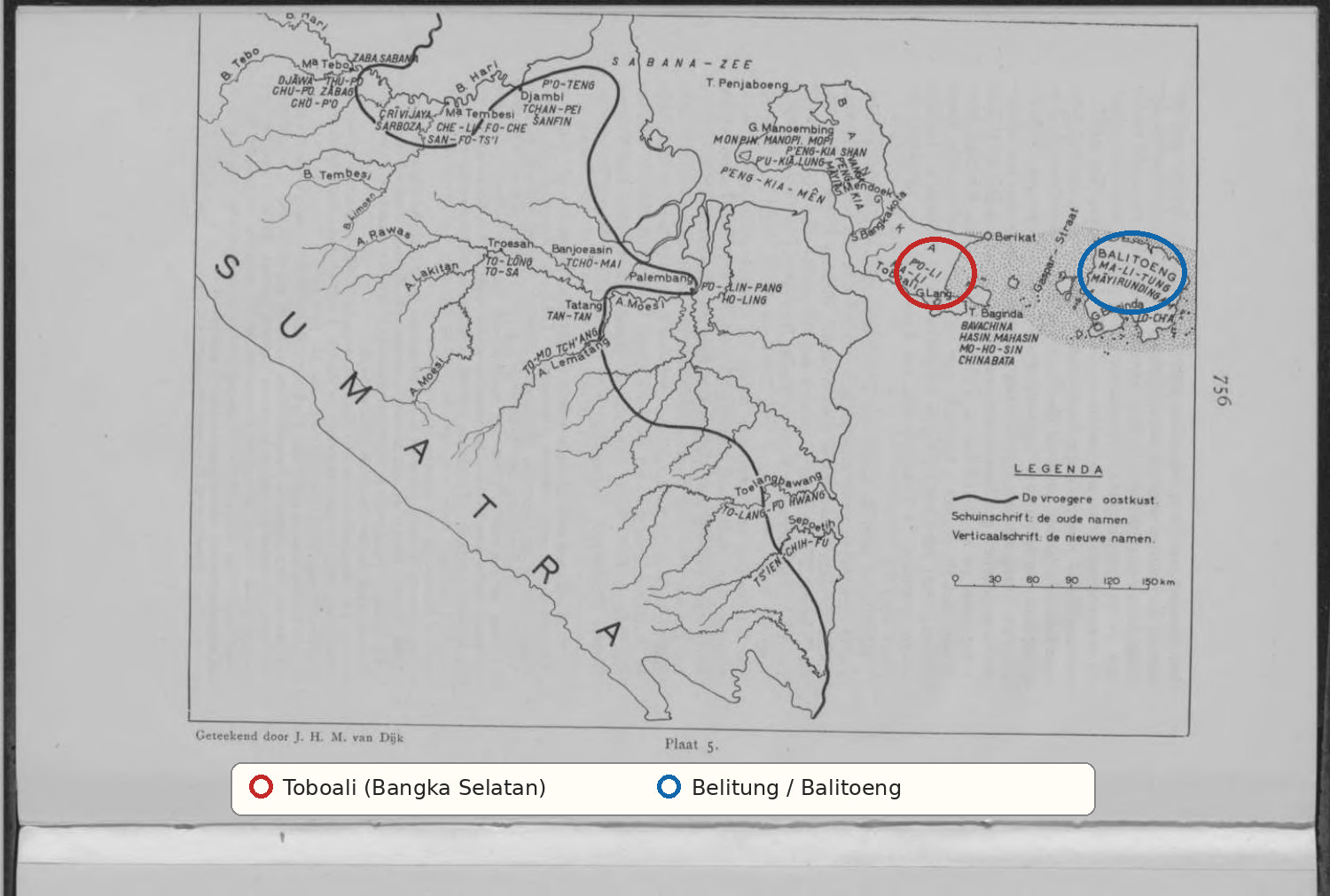
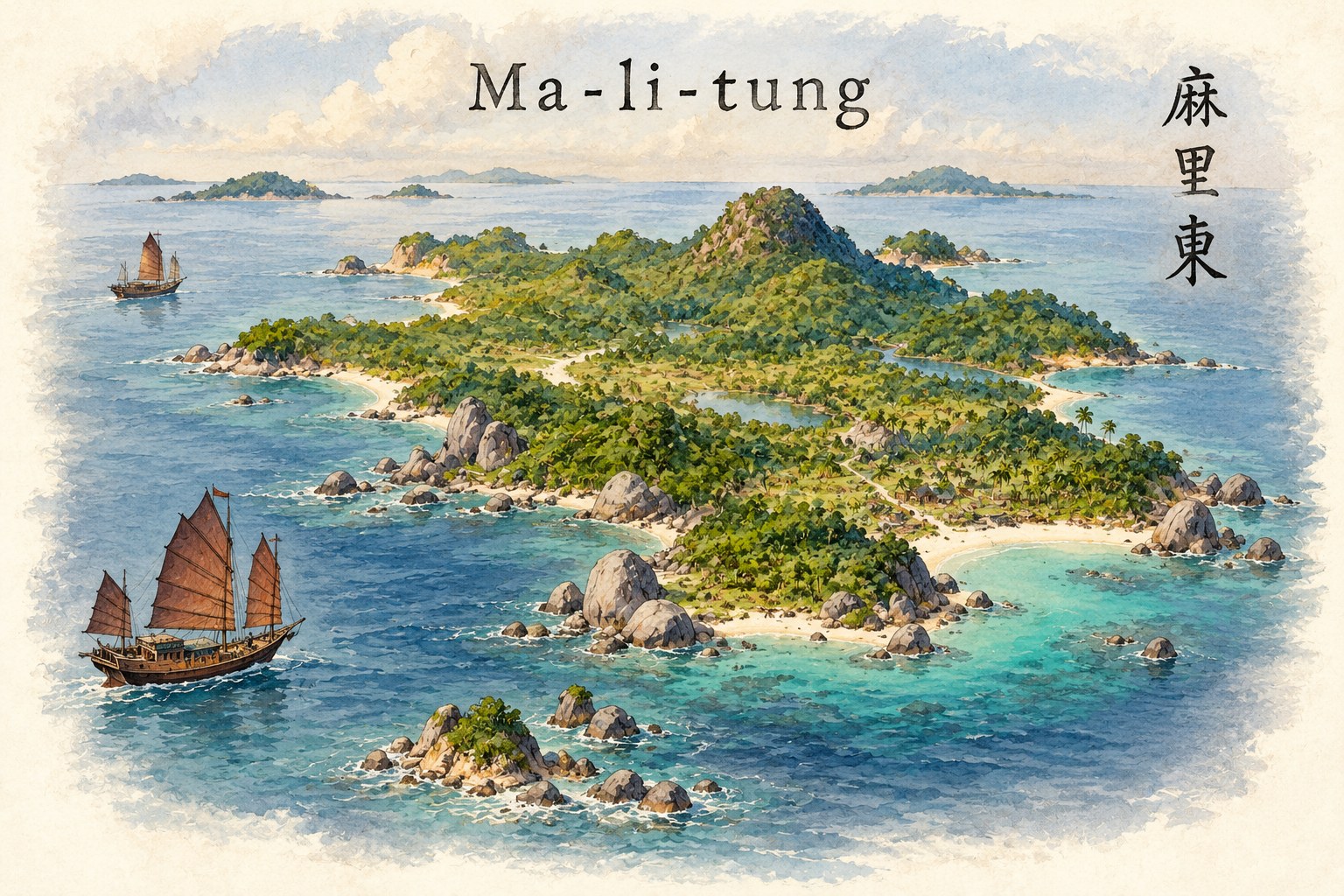
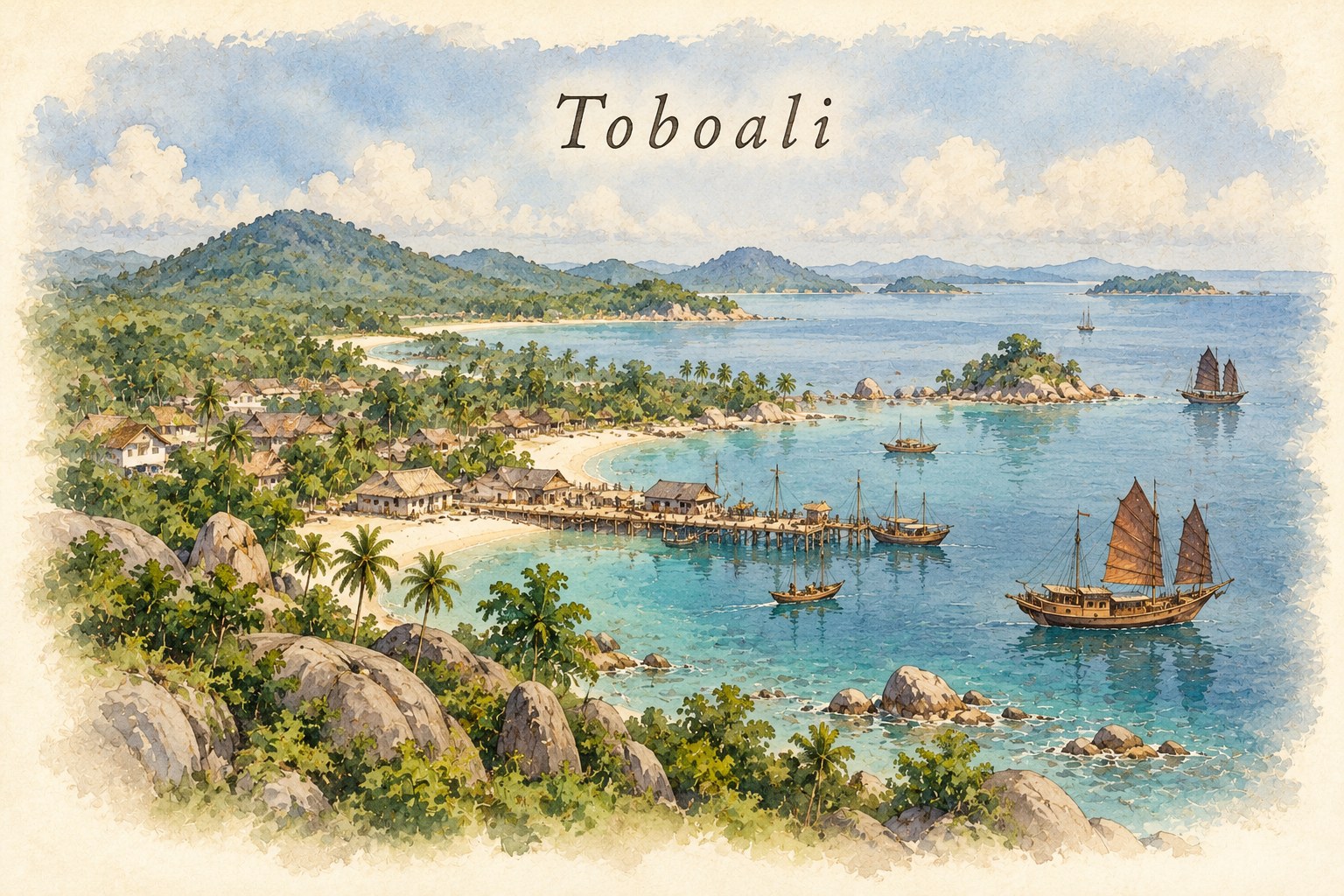
The proposed connection between the names Ma-li, Toboali and Ma-li-tung is Obdeijn’s hypothesis, not a verified etymology.
A chronology from the 1939 account
The account places Bangka under the Buddhist realm of Srivijaya, centred on Palembang.
After the fall of Palembang to Majapahit, Bangka is described as coming under Javanese influence.
Crijn van Raemburch encounters Sarampoe, described in the source as the “King of Bangka”.
The account records a VOC agreement with the ruler of Bangka and Billiton.
A daughter of Boepati Noesantara marries Sultan Abdurrachman of Palembang.
The source says official VOC records first mention the occurrence of tin on Bangka.
Regular Chinese immigration is said to have begun, closely linked to the developing tin industry.
Van den Bogaart and Captain Lombart reportedly encounter 55 workings with 680 Chinese miners.
Bangka is reported to have about 13,400 inhabitants, including more than 1,700 miners.
Serious disturbances among miners are recorded at Toboali and around Pangkalpinang.
The account links unrest among Chinese miners to the drievingerenverbond and names Lioe Ngie as its leader.
Early political history
The 1939 narrative says that after sea raiders were defeated, the people of Bangka submitted to two leaders: Sjatah of Johor and Radja Alam of Minangkabau. Bangka subsequently passed through the authority of Johor and Minangkabau before coming under the Sultan of Banten.
The account then introduces Boepati Noesantara, a follower of the Sultan of Banten who established himself at Banka-Kota. Significantly, the text describes him as “Radja van Banka en Billiton” — Raja of Bangka and Belitung.
This diagram represents only the succession described in the 1939 article. It is not presented as a complete royal genealogy.
The tin turning point
The article records several traditions about the discovery of tin. One associates it with Batin Anjor during a ladang fire in the Merawang area; another concerns the Pakoe region. The writer considered more likely a tradition in which a person from Siantan, familiar with tin processing in Malacca, recognised tin ore near the Olim River in the later Toboali district.
Official VOC documents are said to mention Bangka tin in 1717. Around that time, the account says, Muntok was founded by a local chief called Pa Mento, from whom the place supposedly took its name.
“Sinds 1725 had een geregelde immigratie van Chineezen plaats.”De Mijnbond jubilee issue, 1939
The account singles out a Chinese man named Sing, associated with a settlement at Belo. Sing is credited with improving mining methods, encouraging open workings and a more effective use of water. The narrative connects this development with the spread of mining to Klabat, Djeboes, Soengailiat, Merawang, Pangkalpinang and Koba.
Chinese communities
By 1803 the Chinese presence in Bangka's mining economy was substantial. The expedition of Resident Van den Bogaart and Captain Lombart reportedly found 55 mining operations with 680 Chinese miners, while Van den Bogaart suspected that not everything had been shown to him.
The same publication describes older Chinese mining technology, including the Chineesche kettingpomp, or Chinese chain pump. In its broader discussion of Bangka mining, it also states that the actual extraction had long been carried out by the Chinese population before European technical supervision became more important.
Mining society was not without conflict. The article attributes repeated disturbances to grievances over payment, rice distribution or working conditions. It records major unrest at Toboali in 1839 and around Pangkalpinang in 1842. For 1900 it mentions the drievingerenverbond (“three-finger association”) and names Lioe Ngie as its leader. The source does not establish precisely what kind of organisation this was, so it should not automatically be identified as a kongsi or secret society without further evidence.
Belitung's own tradition
The 1939 account places Bangka and Belitung within a wider political history and associates both islands with Boepati Noesantara and Palembang. It does not, however, provide the complete succession of Belitung's Depati.
For that story, Riwajat kedipatian Belitung is a separate and more appropriate source. Its catalogue description records an original manuscript once in the hands of J.H. Koster of Dordrecht. The two traditions are therefore best kept distinct while allowing readers to explore how they may relate.
Explore the Kedipatian of Belitung →Source & method
Primary source used for this page: Jubileumnummer uitgegeven ter gelegenheid van het 20-jarig bestaan van den Mijnbond, 1939. The historical narrative appears within this jubilee publication of the mining-service personnel organisation.
The spelling of historical names follows the source where practical: Banka, Billiton, Boepati Noesantara, Sarampoe, Pa Mento and Lioe Ngie. Modern Bangka and Belitung are used in the surrounding English text.
Additional source for the island-name section: P. Hövig, “Hoe kwam Banka aan zijn naam?”, Erts: Maandblad der Billiton Bedrijven, 1950, four instalments beginning on printed pages 98, 116, 154 and 174. Oral traditions and proposed etymologies are distinguished from independently established facts.
Early events in this article are presented as claims or traditions recorded by the 1939 source. Further archival comparison is required before treating every early date, title and succession as independently verified fact.