Fauna of Billiton · Historical natural history
Mammals of Billiton: Abbott's 1904 Expedition
A rare scientific record of Billiton's mammals, landscapes and collecting localities at the beginning of the twentieth century.
The expedition and its publication
Dr. W. L. Abbott collected mammals on Banka, Billiton and the neighbouring island of Mendanau between 20 January and 14 August 1904. Marcus Ward Lyon, Jr., later examined 274 specimens from the three islands for the United States National Museum and published “Mammals of Banka, Mendanau, and Billiton Islands, between Sumatra and Borneo” in Proceedings of the United States National Museum, volume 31, number 1498 (1906), pp. 575–612.
The figure of 274 specimens refers to all three islands together, not to Billiton alone. Names below reproduce the historical classifications in Lyon's paper; modern scientific names may differ.
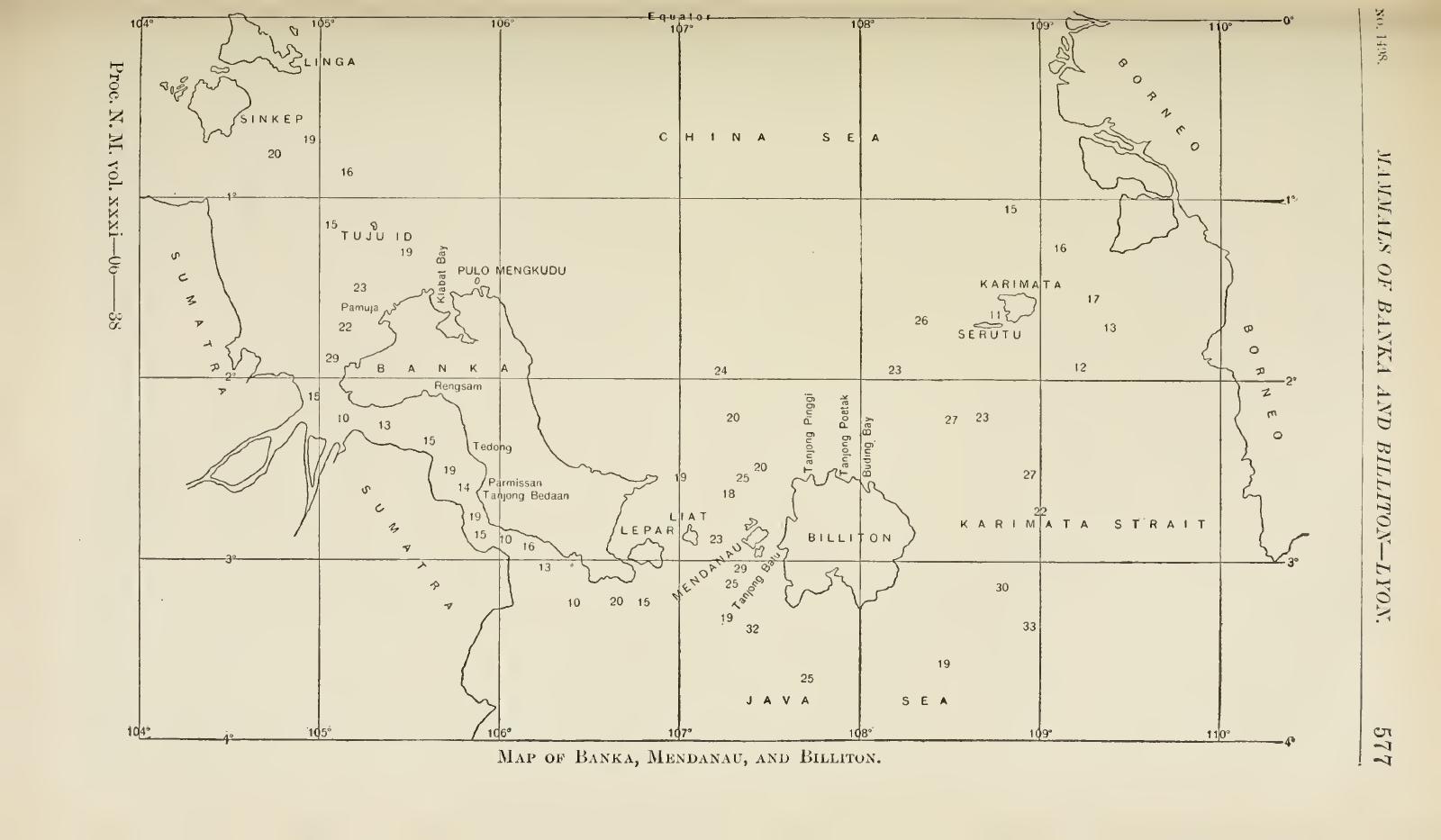
Map of the collecting region
The original map on printed page 577 shows Banka, Billiton and Mendanau. It helps place the expedition's collecting stations in their historical geographical context.
Source: Lyon (1906), p. 577. Historical map reproduced from the supplied publication.
Selected mammals documented on Billiton
| Name in Lyon's publication | Animal | Evidence and localities |
|---|---|---|
| Tragulus billitonus | Mouse-deer / chevrotain (pelanduk) | Ten specimens from Tanjong Batu, Bukit Menguru and Tanjong Poetak; type collected 20 July 1904. |
| Muntiacus bancanus | Muntjac / barking deer (kijang) | Antlers and a frontlet recorded from Buding Kampong, Billiton; the species description was based primarily on Banka specimens. |
| Rusa brookei | Sambar deer (rusa) | Five Billiton specimens from Buding Kampong and Buding Bay. |
| Ratufa polia | Giant squirrel (bajing raksasa) | Specimens recorded from Tanjong Batu, Buding Bay, Tanjong Poetak and Bukit Menguru. |
| Sciuropterus vordermanni | Flying squirrel (bajing terbang) | One adult female from Buding Bay. |
| Mus cremoriventer | Rat (tikus) | One specimen from Billiton; Lyon cautioned that the material was insufficient for firm conclusions. |
| Viverra tangalunga | Malay civet (musang tenggalung) | Two individuals collected on Billiton. |
| Paradoxurus canescens | Palm civet (musang) | Described as a new species in the historical publication; type from Tanjong Batu, 19 July 1904. |
| Tarsius tarsier | Tarsier (tarsius) | One adult female from Buding Bay; Lyon explicitly questioned its identification. |
| Macaca phaeura | Macaque (monyet) | Two specimens collected on Billiton. |
| Presbytis cristata | Leaf monkey / langur (lutung) | One specimen from Billiton. |
This is a selection, not a complete checklist. Historical names are not necessarily current accepted names. The original article should be consulted for full specimen measurements and descriptions.
What Abbott wrote about Billiton
In his field notes, Abbott described a landscape extensively affected by tin mining. He reported secondary forest and grassland in many areas, with remaining old-growth forest especially around Bukit Menguru, west of Buding Bay. His observations provide an important historical snapshot, but do not establish the extent of forests today.
Abbott also reported that wild pigs were common, although he personally saw only one. He heard that pangolins (written as Manis) occurred, but this was not a confirmed specimen record in the passage. The notes include observations on people and mining settlements, expressed in colonial-era language that should be read critically.
Why Billiton interested zoologists
On the basis of the specimens examined, Lyon considered the mammal fauna of Banka and Billiton to show particularly close zoological affinities with Borneo, despite the islands' proximity to Sumatra. This was an interpretation made from the material available in 1906, rather than a definitive statement about all mammals living on the islands today.
Primary source
Lyon, Marcus Ward, Jr. (1906). “Mammals of Banka, Mendanau, and Billiton Islands, between Sumatra and Borneo.” Proceedings of the United States National Museum 31 (1498): 575–612. Based on specimens collected by Dr. W. L. Abbott in 1904. See especially pp. 575–576, 577 (map), 578–579, 583–585, 586–589, 593–607 and 608–609 (field notes).