Long before industrial tin mining transformed Belitung, maritime communities travelled and worked among the islands, bays and straits of the region. The historical name Orang Sekah appears in nineteenth-century accounts of Belitung's coastal society. Their history should not be reduced to a single label such as “pirates”.
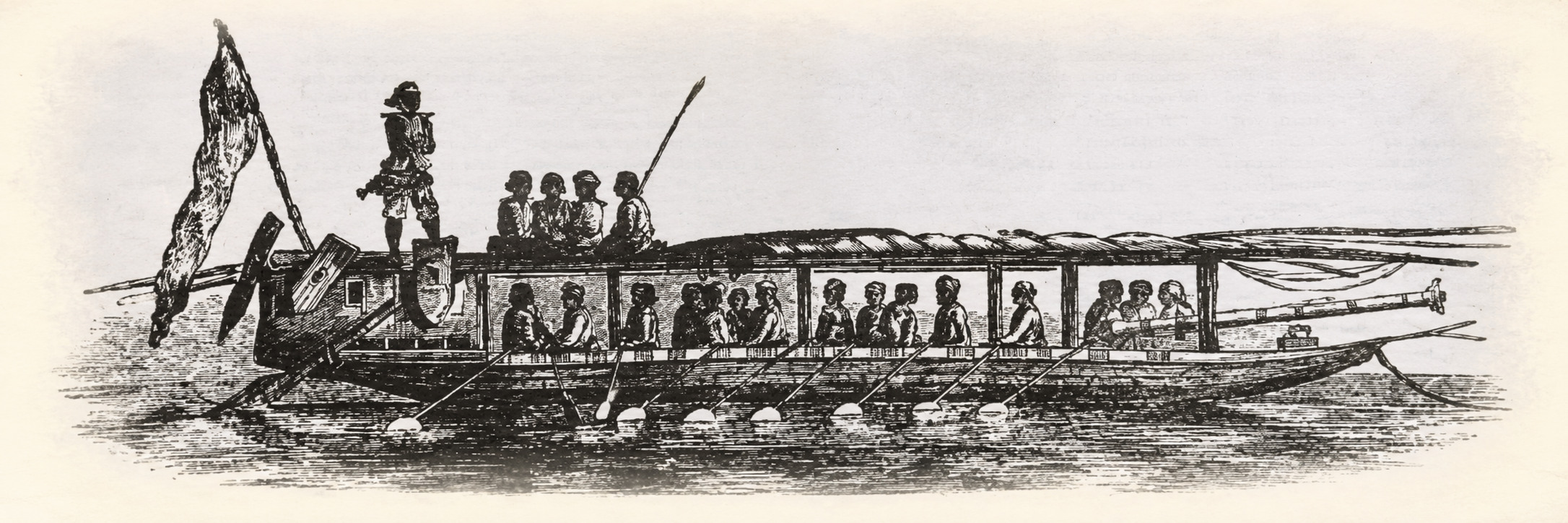
Sea people and regional networks
The supplied Indonesian-language chapter, Di bawah bayang-bayang bajak laut, discusses sea-oriented communities within the broader history of Sriwijaya, shipping, political authority and maritime raiding. Its section Orang laut dan bajak laut (printed pp. 24–25) presents sea people as part of a much larger regional world. This is useful background for Belitung, but regional descriptions should not automatically be attributed to the island's Orang Sekah.
What Loudon recorded on Belitung
John F. Loudon's De eerste jaren der Billiton-Onderneming (1883) contains more geographically specific observations. His memorandum from June 1853 describes five principal divisions of Orang Sekah and names smaller groups and their leaders. Loudon associated them with fishing, collecting sea products, and living aboard boats.
| Division in Loudon's spelling | Recorded subdivisions / leaders |
|---|---|
| Ketappang | Lantan; Ma Lis; Ma Riegnoe; Ma Lada; Ma Rentjeh; Batin Anim; Oenas; Djawa; Ma Tjentoe; Ma Medar |
| Parrak | Ma Deman; Ma Minga; Awal; Entas; Lotang; Ma Sagie |
| Blantoe | Ma Minah; Ma Rantjang; Ma Selat; Ma Bali; Ma Lanang; Ma Intan; Ma Kotjeh; Ma Petak |
| Olim | Batin Adjar; Ma Sarina; Ma Cherbon; Ma Latjoet |
| Djoeroe | Djoeroe Krah; Pa Sariena |
Source: Loudon (1883), printed pp. 20–22. These are historical spellings and the recorded names of leaders or subgroups, not necessarily fixed modern ethnic categories.
Trade, navigation and the Bangka connection
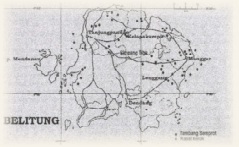
According to Loudon (printed p. 23), Orang Sekah around Tandjong Pandan maintained boat connections with Toboalie on Bangka. His account also distinguishes them from groups he placed around Blantoe, on Belitung's southern and eastern coasts. These details show how sea routes connected island communities well before modern transport infrastructure.
How should we understand accounts of piracy?
Both the supplied chapter and Loudon's colonial-era narrative discuss piracy, political conflict and attacks on shipping. Such accounts deserve attention, but they were written from particular historical perspectives. A maritime community could include fishers, navigators, traders and people involved in armed conflict; these roles must not be assumed to describe every member of that community.
In particular, the supplied chapter's discussions of Sriwijaya and the wider Strait of Malacca region provide context, not direct evidence that Belitung's named Orang Sekah groups participated in every event described there.
Why this history matters
Belitung's maritime heritage is more than the history of ships and raids. It is also the story of families living at sea, knowledge of tides and coastlines, exchanges between islands, and communities whose voices are only partly preserved in written archives. Reading Indonesian historical writing alongside Loudon's record helps us ask better questions while acknowledging the limitations of each source.
Historical sources and notes
- Sutedjo Sujitno, Timah Indonesia Sepanjang Sejarah, “Di bawah bayang-bayang bajak laut,” pp. 22–38; especially “Orang laut dan bajak laut,” pp. 24–25, and “Belitung,” pp. 37–38. Publisher and publication year are not yet verified from the supplied extract.
- John F. Loudon, De eerste jaren der Billiton-Onderneming (1883), printed pp. 18–23, particularly the Orang Sekah memorandum written in June 1853.
Editorial note: historical descriptions of “piracy” and beliefs reflect the authors' terminology and viewpoints. The boat artwork above is a modern reconstruction inspired by the illustration on pp. 22–23, not an unaltered historical image. The historical map is reproduced from the supplied book extract.