Chinese miners and the eighteenth-century tin economy
In his chapter on the Malay-Riau trading world, Sujitno places the arrival of Chinese mining workers within the expansion of tin production in Bangka. Mining was connected to royal authority, the demand for tin, the recruitment of workers and the organisation of mining settlements. His section Kedatangan Orang Tionghoa also describes the difficult circumstances in which migrants worked and lived. [Sujitno, 1996, pp. 68–73]
1. Excavating tin-bearing ground
Before mechanised excavation, workers dug the earth manually and prepared the material for separating tin-bearing minerals. Sujitno's epilogue describes the Chinese mining era and identifies the changkol (hoe or digging tool) among the techniques associated with Chinese mining. The specific layout of a mine, its depth and its working sequence could vary; the source does not provide a complete step-by-step operating manual for every Bangka or Belitung mine. [Epilogue, pp. 363–364]
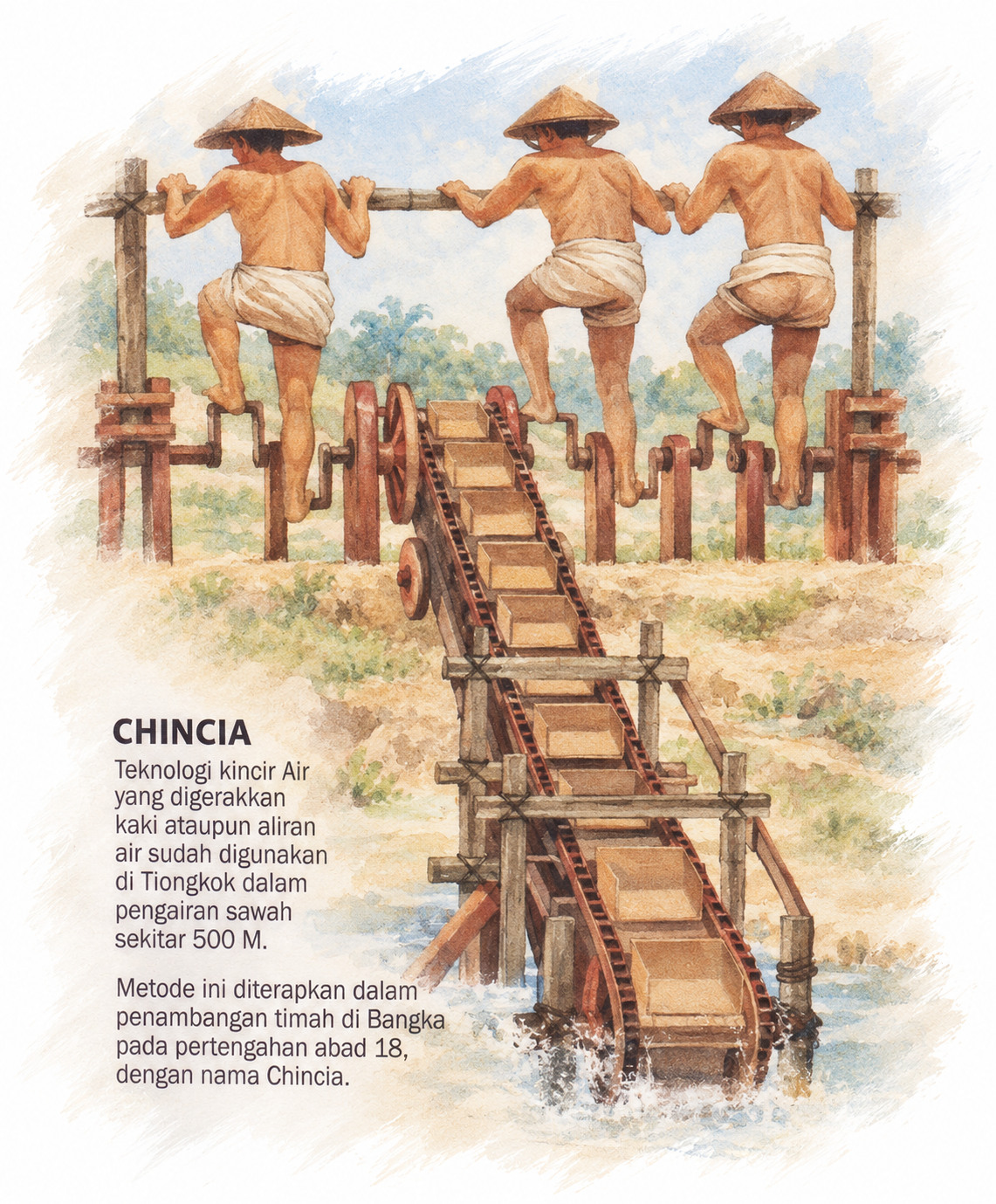
2. Removing water: the chinchia
Water was a major practical obstacle to digging. An illustration reproduced by Sujitno shows a manually operated water-lifting apparatus labelled chinchia, presented as part of the technology introduced by Chinese migrants to Bangka in the early eighteenth century. The illustration shows several workers operating the mechanism. It should not be confused with the much later steam-powered mining machinery or bucket dredgers. [Chapter, p. 71, illustration and caption]
3. Washing and separating tin ore
Once earth had been excavated, ore-bearing material had to be processed to concentrate the heavier tin minerals. Sujitno's treatment of traditional mining places these operations within the wider development of techniques before industrial mechanisation. The pages supplied do not identify a dated washing installation in eighteenth-century Tanjung Pandan. [Epilogue, pp. 360–364]
4. The kongsi: organising work and daily life
Mining technology depended on people as well as tools. Sujitno describes the kongsi as an important organisation within Chinese mining communities, encompassing labour arrangements and aspects of communal life. A historical photograph reproduced on page 70 shows workers gathered in a shared dining space. This is evidence for the social history of mining, not a dated image of an eighteenth-century Belitung mine. [Chapter, pp. 70–73]
5. From hand tools to industrial mining
The contrast with later technology is substantial. Sujitno's epilogue separately discusses changes under Chinese, British and Dutch mining regimes and the subsequent development of bucket dredgers. These later innovations should not be projected back into the early eighteenth century. [Epilogue, pp. 363–366]
What can we say about Belitung?
| Documented in the supplied book | Still to be established for Belitung |
|---|---|
| Chinese miners and mining organisation in Bangka. | When comparable mining communities first operated in Tanjung Pandan or elsewhere on Belitung. |
| The chinchia water-lifting technology in Bangka. | Whether the same apparatus was used at a specifically identified early Belitung mine. |
| Development from manual methods to later mechanisation. | Dates, sites and surviving material evidence for each stage on Belitung. |
Sources and further reading
Sutedjo Sujitno, Timah Indonesia Sepanjang Sejarah (1996), chapter Kerajaan Melayu-Riau, printed pp. 64–73 (especially pp. 70–73 and the illustration on p. 71); Epilog, printed pp. 358–366 (especially pp. 363–364 on Chinese mining technology and p. 366 on dredgers). Page numbers refer to the printed book, not PDF scan numbers. This article paraphrases the sources and explicitly separates Bangka evidence from unresolved Belitung questions.
Related: The Malay-Riau Kingdom and Early Chinese Tin Mining · Tin Mining · Back to History