Preparing the materials
The article identifies clay and kaolin from Billiton, quartz sand partly from the island, and feldspar imported from India. Materials were crushed, mixed, milled and filtered.
HISTORY · INDUSTRY & CRAFT
A little-known chapter of the island's industrial past, documented in a 1954 issue of Erts — Maandblad der Billitonbedrijven.
Tandjong Pandan · Historical account from 1954
THE HISTORICAL RECORD
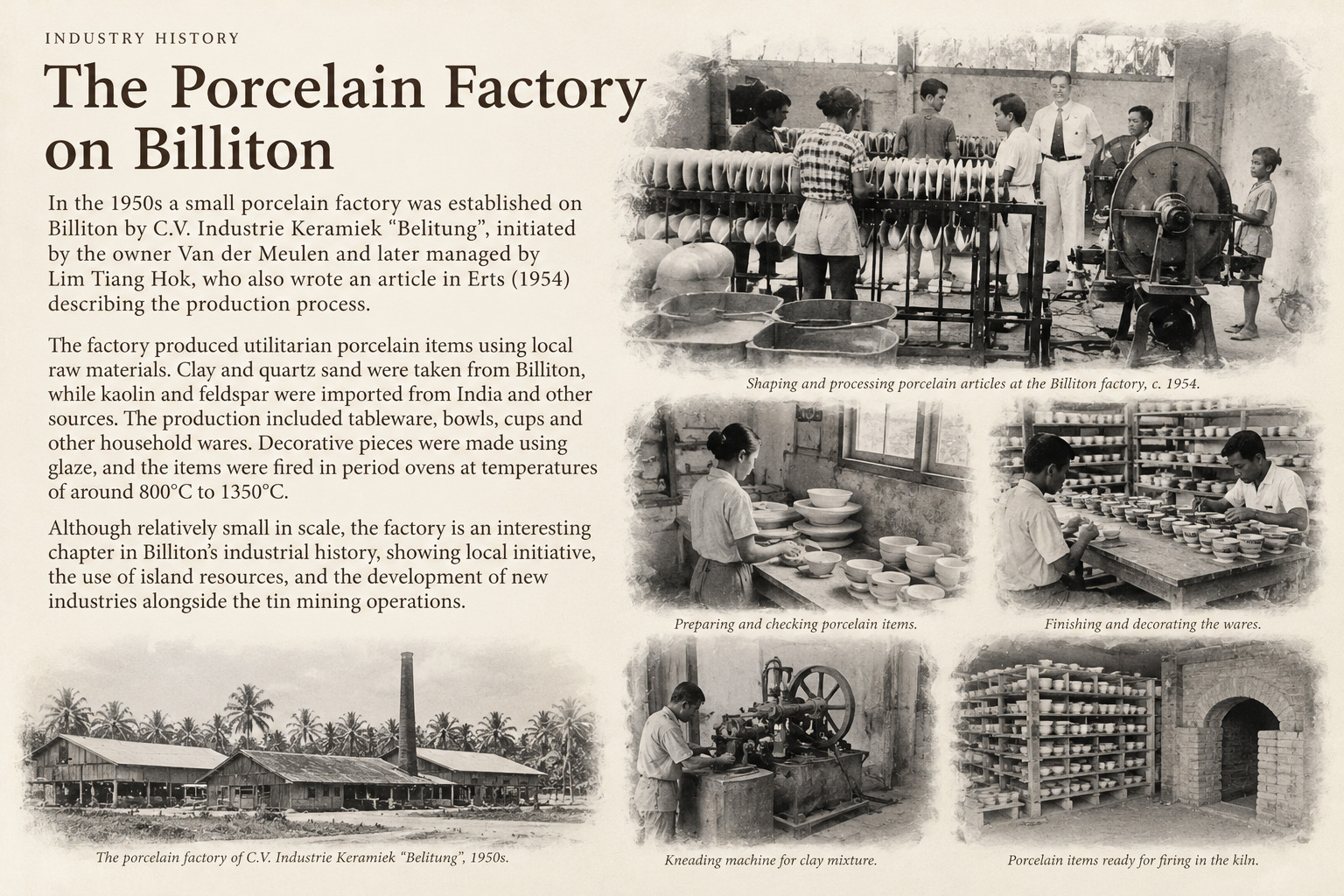
In 1954, Lim Tiang Hok described the porcelain factory C.V. Industrie Keramiek “Belitung” in Tandjong Pandan. His article, “Porceleinfabricage op Billiton”, appeared in Erts, pages 195–198.
Lim Tiang Hok was the factory's owner. The article arose after a visit by Ir. J. F. W. van der Meulen, who suggested that the factory's work be introduced to readers of the magazine. The article reports that the factory had begun producing porcelain after a difficult period of preparation and construction, although output was still modest.
The factory made practical and decorative ceramic wares, including cups, plates, bowls and other articles. It illustrates an effort to develop local manufacturing alongside Billiton's better-known tin industry.
FROM CLAY TO PORCELAIN
The article identifies clay and kaolin from Billiton, quartz sand partly from the island, and feldspar imported from India. Materials were crushed, mixed, milled and filtered.
Clay was cast in plaster moulds or shaped on electrically driven potter's wheels. The formed pieces were dried before firing.
The initial biscuit firing took place at approximately 800°C, producing a porous body ready for glazing.
Glaze firing took place at approximately 1,350°C. Decorative patterns and colours could be applied in additional stages.
THE ORIGINAL DOCUMENT
The four-page article contains twelve numbered black-and-white photographs. They show factory machinery, filter presses, a clay-kneading machine, moulding, workers finishing articles, shelves of wares, decoration and glaze testing. These documentary photographs are distinct from the artistic illustration above.
Historical note: The article does not give a confirmed foundation year, precise street address or date of closure for the factory. These details require additional archival research.
Source: Lim Tiang Hok, “Porceleinfabricage op Billiton”, Erts — Maandblad der Billitonbedrijven (1954), pp. 195–198.