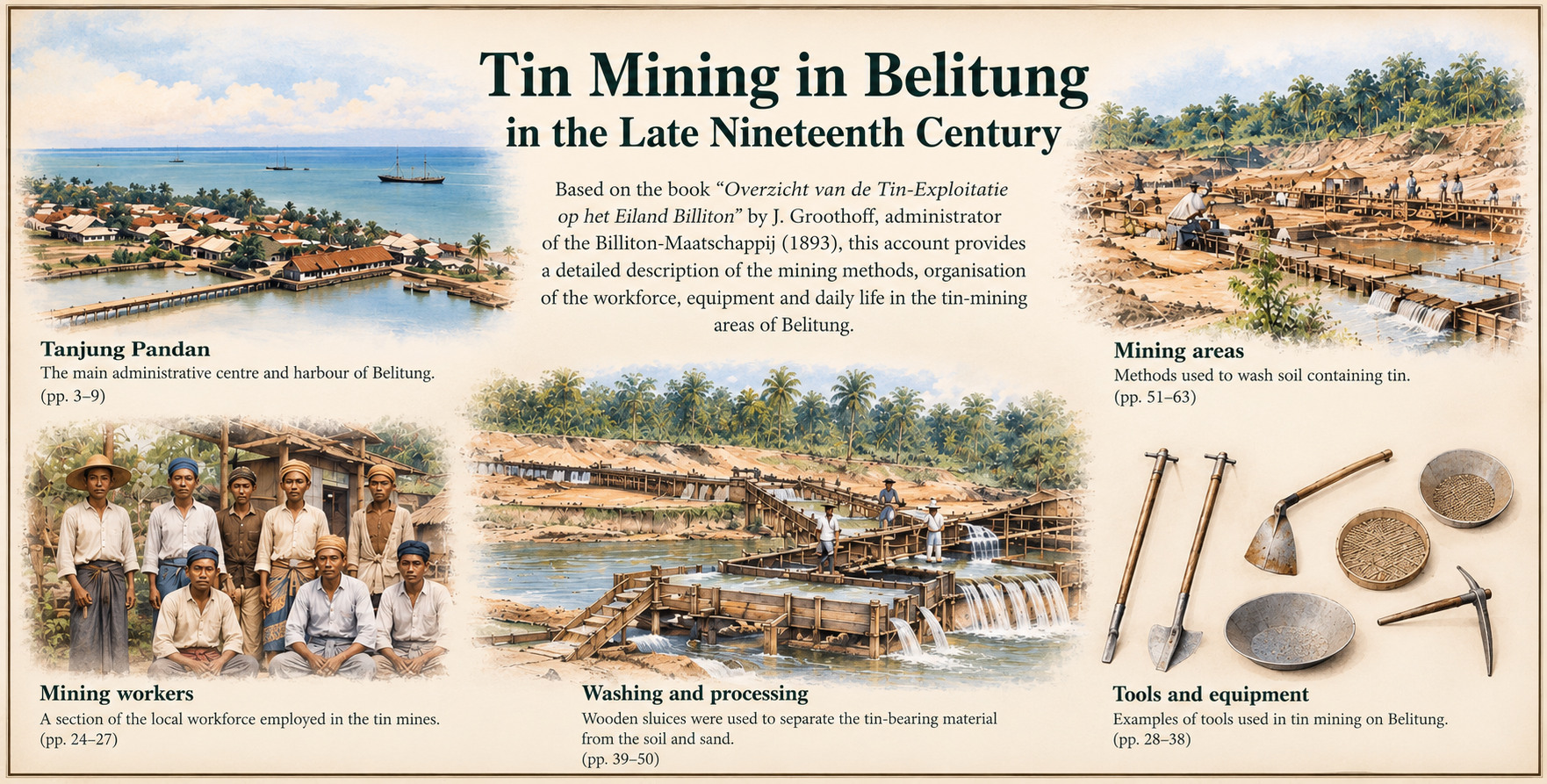
During the nineteenth century, tin mining became a defining part of Billiton's changing landscape and economy. Rivers, valleys and mineral-bearing ground were investigated and reshaped for extraction. Around the mines grew networks of work, settlement, supply and administration. A remarkable account of these processes survives in a Dutch book published in 1893 by J. Groothoff, an administrator of the Billiton-Maatschappij.
An island organised around mining
Groothoff begins with the administration of the island and its mining districts. He identifies Tandjong-Pandan as an administrative centre and describes a system of district management and mine supervision. His account makes clear that mining was not confined to a single excavation: it required records, stores, transport, inspections and communication between scattered operations. [1, pp. 3–9]
The document is especially useful for understanding how the company saw and organised its work. It is less complete as a history of local society: the voices of miners and families rarely appear directly.
Finding tin beneath the ground
Before an area could be worked, teams examined the terrain and searched for promising deposits. Groothoff describes exploratory digging and drilling, recording soil layers, and estimating whether a deposit could support mining. The geological discussion distinguishes tin-bearing material in different formations and explains how prospectors tried to judge its value. [1, pp. 10–31]
Such investigations were practical as well as scientific. A deposit might be rich in ore yet difficult to work if the terrain or the available water made extraction costly.
Chinese workers, foremen and craftspeople
Chinese communities played several documented roles in the mining economy. Groothoff refers to Chineesche mandoors (Chinese foremen) and Chinese workers in his description of mine organisation and prospecting teams. The book also discusses the tools used by miners and states that some were obtained through Chinese blacksmiths and traders on the island. [1, pp. 31–32, 66]
These references are important because they show a range of activities beyond digging ore: supervision, skilled metalwork and supplying equipment were also part of the economy. They do not, however, establish the names, origins or family histories of individual Chinese residents. Those questions require additional records, such as almanacs, company archives, inscriptions and family documents.
Water as a mining technology
Water was essential to many of the methods described by Groothoff. Channels, embankments, reservoirs and washing arrangements helped move and separate soil so that heavier tin-bearing material could be recovered. The book includes technical diagrams explaining the operation of channels and excavation methods. [1, pp. 44–64]
These pages are particularly valuable for a digital museum. They allow readers to understand why waterways and earthworks were as important to mining as the tools in a worker's hands.
The settlements around the mines
Mining also required places to live and work. Groothoff includes a small layout drawing of a worksite settlement, showing how accommodation and working spaces were arranged near an operation. The illustration offers a glimpse of the built environment surrounding the mines, although it is a schematic plan rather than a photograph of a named village. [1, p. 43]
Tools, skills and everyday labour
Illustrations of picks, hoes, shovels and other equipment appear in the book's technical discussion. Groothoff describes how tools were used and maintained, including the involvement of Chinese craftspeople and traders in their supply. These details connect large-scale mining administration with the everyday material world of workers. [1, pp. 64–66]
Reading the historical record today
Groothoff's 1893 book preserves valuable descriptions of mining technology and company organisation at the end of the nineteenth century. But it is a colonial company account, written primarily to explain operations and management. It should therefore be read alongside other sources if we want a fuller history of Belitung's Malay communities, Chinese families, migrant labourers, women, traders and local leaders.
For Simpur Talang, this is the beginning of a broader story: not only how tin was extracted, but how mining influenced places, relationships, livelihoods and memories across the island.
Historical source and editorial notes
- J. Groothoff (1893). Overzicht van de Tin-Exploitatie op het Eiland Billiton. Primary Dutch-language account by an administrator of the Billiton-Maatschappij. Page references in this article refer to the printed page numbers visible in the book. The supplied scan includes preliminary pages before printed page 3.
- Scope of this article. This overview draws on the book's sections on administration (pp. 3–9), prospecting (pp. 10–31), labour organisation (pp. 31–32), settlements (p. 43), waterworks and extraction (pp. 44–64), and tools (pp. 64–66). It is a selective introduction, not a full translation of the 1893 work.
- Historical names. The spelling Billiton is retained where it reflects the Dutch source; Belitung is used for the island today. The historical terminology in the source is presented for documentation, not endorsement.